

When GCSE results do not match a student's expectations, it is natural for families to wonder whether something has gone wrong.
Perhaps the result is much lower than the school's predicted grade. Perhaps the student was only one or two marks below the next grade boundary. Or perhaps a particular paper appears completely out of line with their usual performance.
In some cases, asking the school to investigate is sensible. However, a review should never be requested simply because a student is disappointed or narrowly missed a higher grade. Parents need to understand what can be checked, how the process works and what risks are involved.
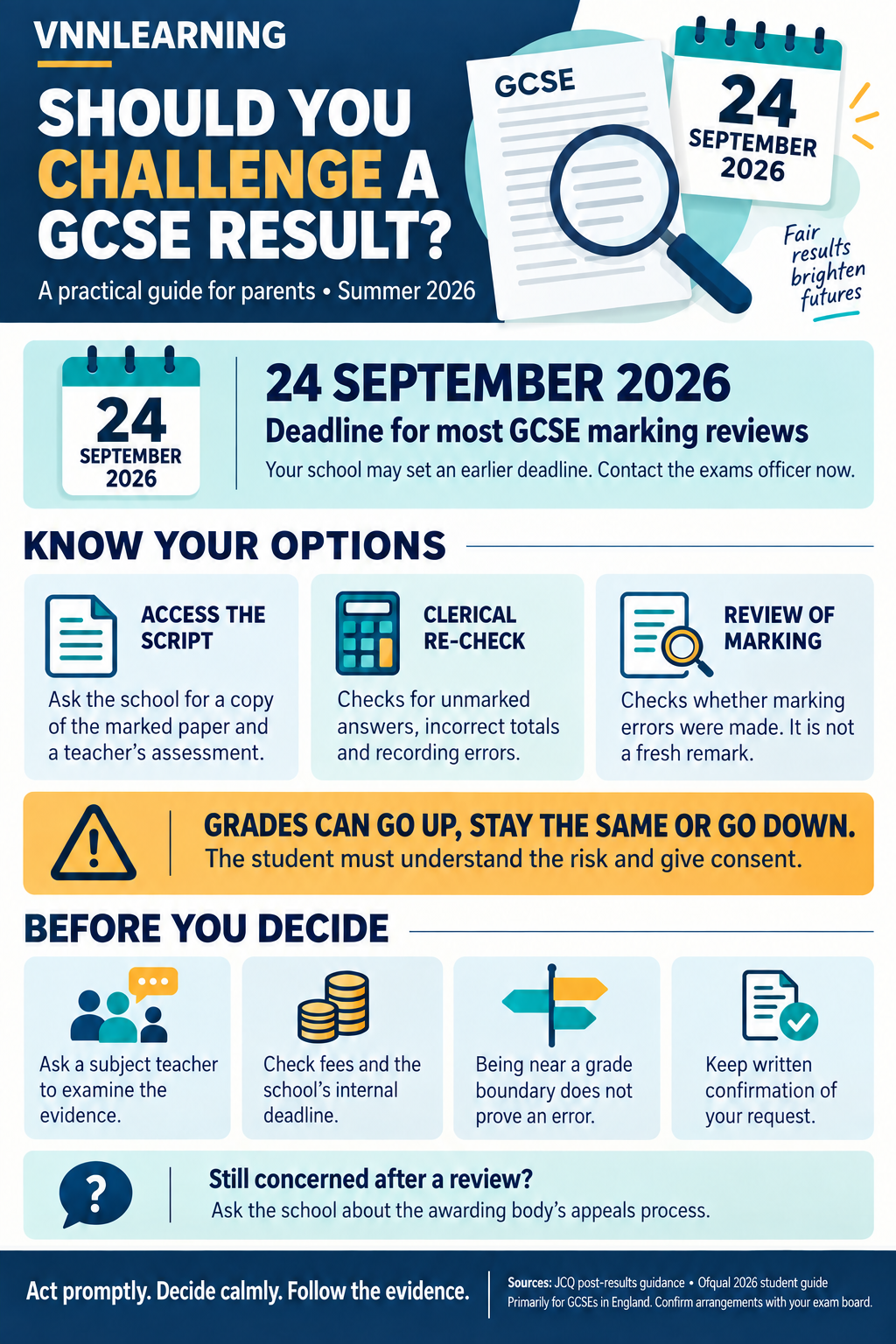
For most summer 2026 GCSE post-results services, requests must reach the awarding organisation by 24 September 2026. Schools and colleges often set earlier internal deadlines, so families who have concerns should contact the examinations officer immediately rather than waiting until the final day.
Is a GCSE remark the same as a review of marking?
The expression "GCSE remark" is widely used, but it is not the official term.
The formal process is called a review of marking. The reviewer does not simply mark the entire paper again from the beginning. Instead, a trained reviewer considers whether the original examiner applied the mark scheme correctly and whether any marking errors were made.
The reviewer must not have been involved in the original marking of the assessment.
A review can correct a genuine error, but it is not intended to replace one reasonable academic judgement with another merely because a second examiner might have awarded a different mark.
What post-results services are available?
Depending on the circumstances, a school may recommend one of several options.
1. Access to the exam script
The school or college can request a copy of the student's marked paper. A subject teacher can then examine the script and compare the awarded marks with the mark scheme.
This can help determine whether there is evidence of a possible marking error or whether the result accurately reflects the answers given.
Obtaining the script is often the most sensible first step. It allows the decision to be based on evidence rather than disappointment, predictions or distance from a grade boundary.
Parents should ask whether the school has requested the original script or a copy. The precise options, deadlines and arrangements can vary between awarding organisations.
2. Clerical re-check
A clerical re-check looks for administrative mistakes. It checks matters such as whether every part of the paper was marked, whether the marks were added correctly and whether the final mark was recorded accurately.
It does not reconsider the examiner's academic judgement.
A clerical re-check may be appropriate when there is reason to suspect that a question was missed or that marks were totalled or transferred incorrectly.
3. Review of marking
A review of marking includes the clerical checks and considers whether the mark scheme was applied correctly.
The reviewer may change individual marks if a marking error is identified. The student's final mark and grade could therefore rise, remain unchanged or fall.
4. Appeal
An appeal is not normally the first stage. It generally follows the outcome of a review of marking and considers whether the awarding organisation followed its procedures properly and fairly.
If a school or college believes the review or another awarding decision was not handled correctly, it can use the awarding organisation's appeals process. Private candidates may have different arrangements and should consult their examination centre and awarding organisation.
When might a review be worth considering?
A review may be reasonable when:
- A teacher examines the script and identifies a question that may not have been marked correctly.
- Part of the examination appears to have been left unmarked.
- The marks awarded do not appear consistent with the published mark scheme.
- The result is unexpectedly different from the student's performance in other papers or assessments, and the school can identify a credible reason for concern.
- A small, supportable correction could affect an important grade required for sixth form, college or another progression route.
Being close to a grade boundary can make the possible consequences more significant, but it does not prove that the marking was wrong.
Predicted grades are also not evidence of an error. Predictions are estimates, and examination performance can be affected by the questions asked, time management, incomplete answers and the quality of the student's responses on the day.
Understand the risk before giving consent
A review of marking does not protect the original result.
The student's mark can:
- Increase
- Remain unchanged
- Decrease
If the mark changes sufficiently, the grade could also go up or down. Schools and colleges must obtain the student's consent before submitting a review because the student needs to understand and accept this risk.
This is particularly important when a student sits close to both an upper and a lower grade boundary. Families should ask the school to explain the possible outcomes before making a decision.
Will parents have to pay?
Awarding organisations may charge for clerical checks and reviews of marking. Schools have different policies on whether these costs are paid by the school or passed to families.
According to Ofqual's guidance, there should be no fee when a review results in a grade change. Nevertheless, parents should confirm the school's arrangements before authorising a request.
Ask the examinations officer:
- Which service is being recommended?
- What will it cost?
- Who will pay the fee?
- Will the fee be refunded if the grade changes?
- When is the school's internal deadline?
- How and when will the result be communicated?
What if the school refuses to request a review?
Most GCSE candidates cannot apply directly to the awarding organisation. Requests are normally made through the school or college that entered the student for the examination.
However, schools and colleges must provide students with an opportunity to appeal if the centre decides not to request a review of marking.
Ask for the school's written post-results policy and its procedure for challenging the decision. Keep communications calm and evidence-based. The central question is not whether the result feels unfair, but whether there are reasonable grounds to suspect an error.
Private candidates may be able to contact the awarding organisation directly or ask the centre where they sat the examination to submit the request.
What parents should do now
If you are concerned about a summer 2026 GCSE result, take the following steps without delay:
- Contact the school's examinations officer. Ask for the school's internal deadline, as it may be earlier than 24 September.
- Speak to the subject teacher or head of department. Ask whether they believe the result is unexpected and whether reviewing the script would be useful.
- Request access to the script where appropriate. A teacher should compare the marked paper with the mark scheme before recommending a formal review.
- Check the grade boundaries. Establish the student's exact mark and how many marks separate it from the grades above and below.
- Ask for a professional assessment. Being one mark short does not automatically mean a review is advisable. The quality of the answers and the defensibility of the existing marks matter more.
- Discuss the possible consequences with your child. The student must understand that the mark and grade can fall.
- Give written consent only when informed. Confirm the service requested, potential fee, risk and deadline.
- Keep copies of all communications. Record when the request was made and what advice the school provided.
Do not overlook the student's next step
A disappointing GCSE result can feel devastating, but it rarely closes every door.
If a review is not recommended, or if the grade remains unchanged, ask the school or college about alternative courses, resit opportunities and any additional support available. GCSE English language and mathematics can normally be retaken in the November examination series by eligible students aged 16 or over.
The most useful response combines accurate procedural advice with a realistic academic plan. A review of marking should address a possible error. Tutoring and structured support should address gaps in knowledge, examination technique or confidence. These are different needs and should not be confused.
Final advice for parents
Act promptly, but do not act impulsively.
Ask to see the evidence, listen to the subject teacher and make sure your child understands every possible outcome. A review can correct a genuine mistake, but it is not a general second chance at an examination.
For most summer 2026 GCSE reviews, 24 September is the awarding body's deadline, and your school may close requests earlier. If you believe there may be a problem, contact the examinations officer today.
For authoritative information, consult Ofqual's guidance on possible mistakes in 2026 results and the Joint Council for Qualifications post-results information. This article primarily concerns GCSEs regulated by Ofqual in England. Arrangements can differ in Wales, Northern Ireland and Scotland.
At VNN Learning, we help students identify the difference between a disappointing result and an underlying learning gap. With the right diagnosis, families can make calm decisions and build a focused plan for the next stage of education.
Concerned about a GCSE result or planning the next step? Get in touch for a free consultation.