

One disappointing test does not tell the whole story.
A pupil may misunderstand a question, have an unsettled week or still be adjusting to a new teacher. Parents get a clearer picture by looking for patterns across homework, assessments and everyday conversations.
An October check-in provides an opportunity to ask what is going well and where help might be useful.
These seven signs are prompts for a conversation. They are not a diagnosis or automatic evidence that your child needs paid tuition.
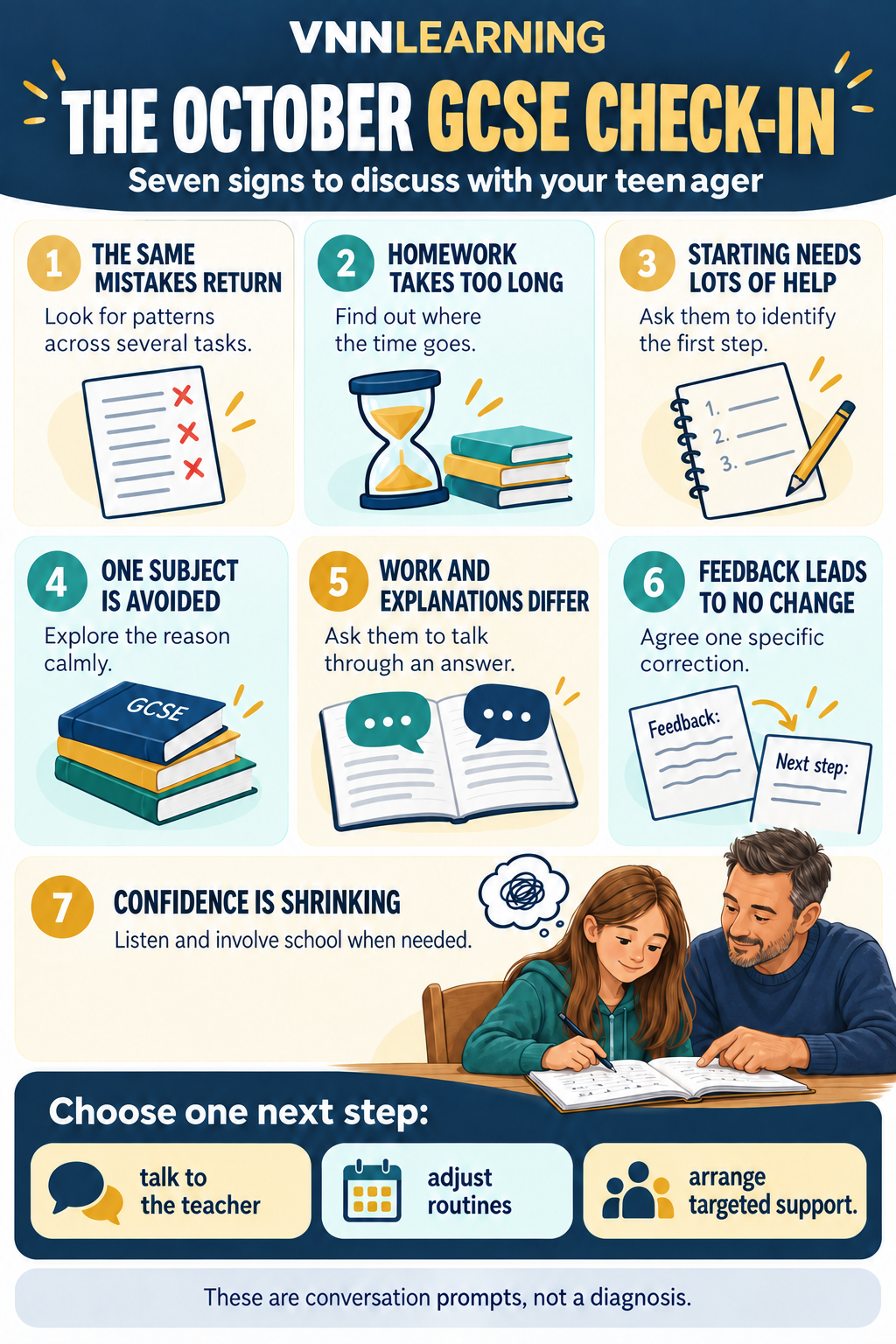
1. The same mistake keeps returning
Look for a difficulty that appears across several pieces of work.
Perhaps your teenager repeatedly mishandles fractions or makes a point in English without supporting it with evidence.
Ask them to show you the teacher's feedback. Can they explain what needs to change? Have they had an opportunity to practise that specific correction?
Repeated mistakes can help identify a precise teaching need.
2. Homework regularly takes far longer than expected
An occasional demanding task is normal. A persistent pattern deserves investigation.
Ask where the time goes. Is your teenager struggling to understand instructions, searching for resources, becoming distracted or rewriting work repeatedly?
Before increasing study hours, clarify the cause. You can also ask the teacher how long the assignment was intended to take.
3. They cannot begin without substantial help
Some pupils understand an example while it is being explained but struggle to start independently.
Ask: "What would your first step be?"
If your child cannot identify one, the difficulty may involve choosing a method rather than completing it.
A teacher or tutor can use that distinction to provide more focused support.
4. They avoid one particular subject
Missing homework, repeated excuses or sudden reluctance around one lesson may deserve a gentle conversation.
Ask what happens in that subject. The issue could involve the work, classroom experiences, relationships or confidence.
Avoid deciding that it is laziness before you understand it. If the concern involves bullying or wellbeing, involve the school's pastoral team.
5. Their explanation and their written work do not match
Your teenager may discuss a topic confidently but struggle to express it in writing. Alternatively, polished homework may mask difficulty explaining the ideas independently.
Ask them to talk through one answer.
This can reveal whether the next step involves subject knowledge, writing structure, interpreting questions or becoming less dependent on help.
6. Feedback is available but nothing changes
Does your child know what the teacher's comments mean?
"Develop your answer" can feel vague to a pupil who does not know what development looks like.
Encourage them to ask for an example, then make one specific improvement. Feedback becomes useful when it leads to a clear action.
7. Their confidence is shrinking
Listen for statements such as "There is no point trying" or "I always get this wrong".
Respond with curiosity. Ask which recent task made them feel that way and look for a manageable next step.
Persistent distress, sleep difficulties or wider changes in behaviour deserve discussion with the school and, where appropriate, a healthcare professional.
Decide on one next action
Bring together a small amount of evidence: a recent task, a repeated difficulty and your child's own view.
Then choose an action. It might be a teacher conversation, a school support session, help organising homework or targeted tuition.
Agree a review point and a concrete goal, such as completing a particular question type with fewer prompts.
Avoid changing everything at once. A focused adjustment is easier to evaluate.
At VNN Learning, the starting point is understanding the difficulty. The most useful support helps a pupil do something independently that they previously could not. If you have noticed any of these signs, get in touch to talk it through.