

Your child has attended several tutoring sessions. They like the tutor, the appointments happen reliably and the homework gets completed.
Is the tuition working?
Half-term is a useful opportunity to review the evidence. Before deciding whether to continue or change, clarify what the support was intended to achieve.
A short period may reveal improvements in understanding without producing an immediate change in an overall school grade. Equally, pleasant sessions should still have a clear educational purpose.
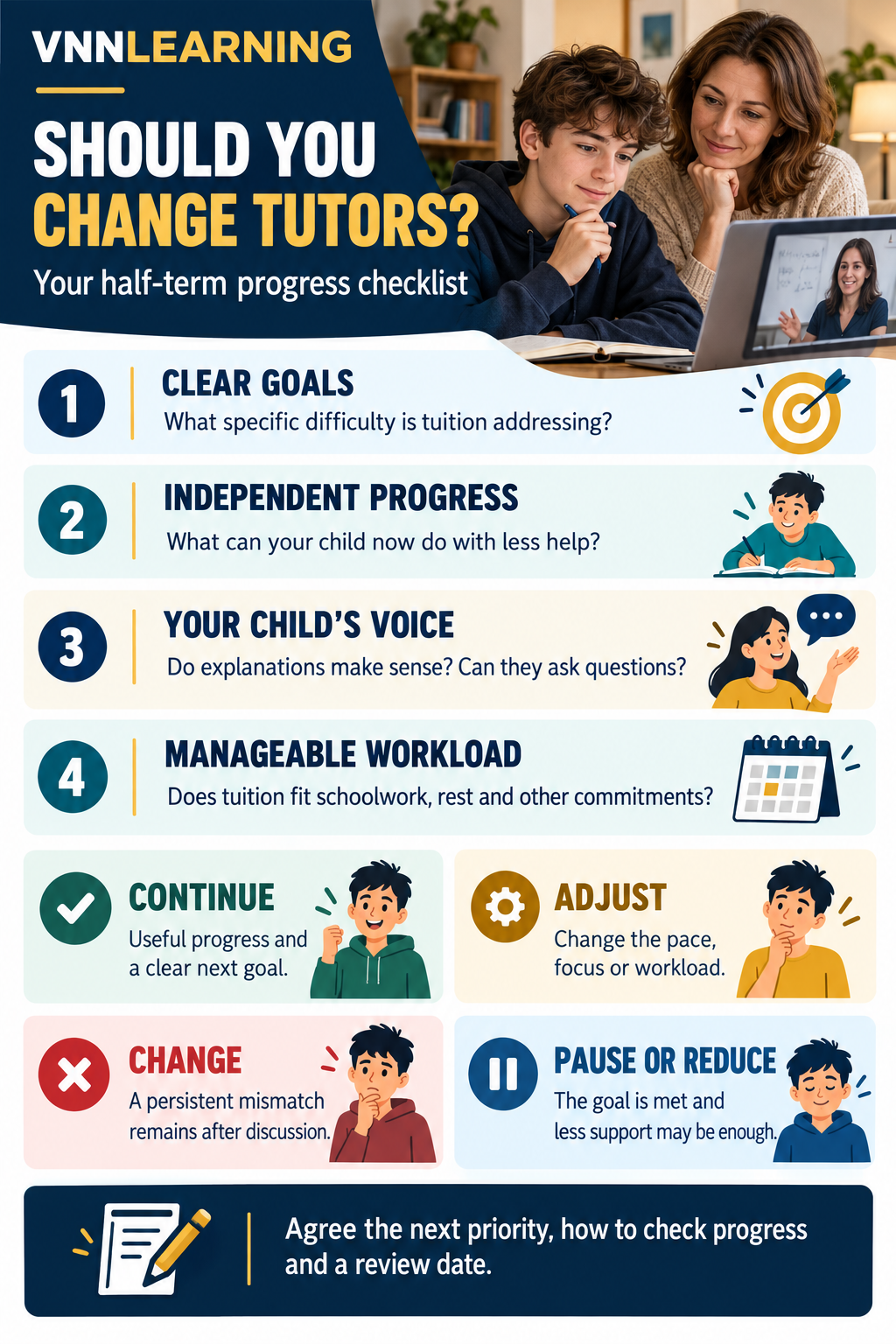
Start with the original goal
What problem led you to arrange tuition?
Perhaps your teenager needed to strengthen algebra, structure analytical paragraphs or recover learning missed through absence.
If the goal was simply "get better at science", make it more specific now.
Ask the tutor to identify the current priority and describe what successful independent work would look like.
A useful goal might be: "Explain and apply this method without needing each step prompted."
Ask what your child can do independently
Request examples from the beginning of tuition and more recent work.
Are errors reducing? Can your teenager explain the reasoning? Can they use the learning in a slightly different question?
Consider how much help they receive. Completing a difficult task with extensive prompting is different from completing it independently.
The Education Endowment Foundation's review of one-to-one tuition highlights the importance of identifying learning needs, connecting support with classroom teaching and monitoring progress. Its findings describe averages across studied interventions, rather than a guarantee for an individual pupil.
Listen to your teenager
Ask specific questions:
- "What makes more sense now?"
- "When do you still get stuck?"
- "Do you feel comfortable saying you do not understand?"
- "What would make the sessions more useful?"
Enjoying tuition matters, particularly if your child previously avoided the subject. But enjoyment and learning should be discussed together.
A quieter pupil may need explicit permission to say that the pace is too fast or the explanations are not helping.
Check the link with schoolwork
Ask whether the tutor understands the qualification, exam board and current classroom topics.
Where appropriate, share recent school feedback with your child's agreement.
The aim is to avoid conflicting priorities or unnecessary duplication. If school has identified a particular misconception, discuss how tuition will address it.
A tutor should also be able to explain why they are revisiting an earlier topic. Sometimes the apparent detour is necessary because a missing foundation is blocking current work.
Consider the total workload
Look beyond the session itself.
Is the additional work manageable alongside school, travel, sleep and other commitments? Does your child understand why between-session tasks have been set?
If tuition creates an unworkable schedule, review the format, frequency or homework load.
More time is useful only when it serves an identified need.
Decide whether to continue, adjust, change or pause
Continue when goals are clear, your child is engaging and the evidence shows useful progress.
Adjust when the relationship works but the pace, focus or workload needs improvement. Agree a change and a review date.
Change tutors when reasonable discussions have not resolved a persistent mismatch in subject expertise, communication or teaching approach.
Pause or reduce support when the original goal has been achieved and your child can manage with less help.
You do not need to wait until half-term to raise a serious concern about conduct or safety.
Leave the review with a plan
Ask for three things: the next learning priority, how progress will be checked and when you will review again.
That makes the decision easier to assess than a general promise that grades will improve.
At VNN Learning, effective tuition should help a pupil become more capable and independent. The right review asks what has changed, what still needs attention and what support is useful next. If you would like to discuss your child's progress, get in touch.
Evidence source: Education Endowment Foundation, One-to-one tuition