
Mock examinations can make GCSEs feel suddenly close.
A teenager who was managing ordinary homework may look at a revision list and see months of learning that apparently needs to be mastered immediately.
Parents can help by turning that large task into a sequence of smaller decisions.
Start with your school's actual timetable. Mock dates, content and arrangements vary, so there is no single national mock-exam schedule to follow.
The six-week framework below is an example to adapt, rather than a requirement for every pupil.
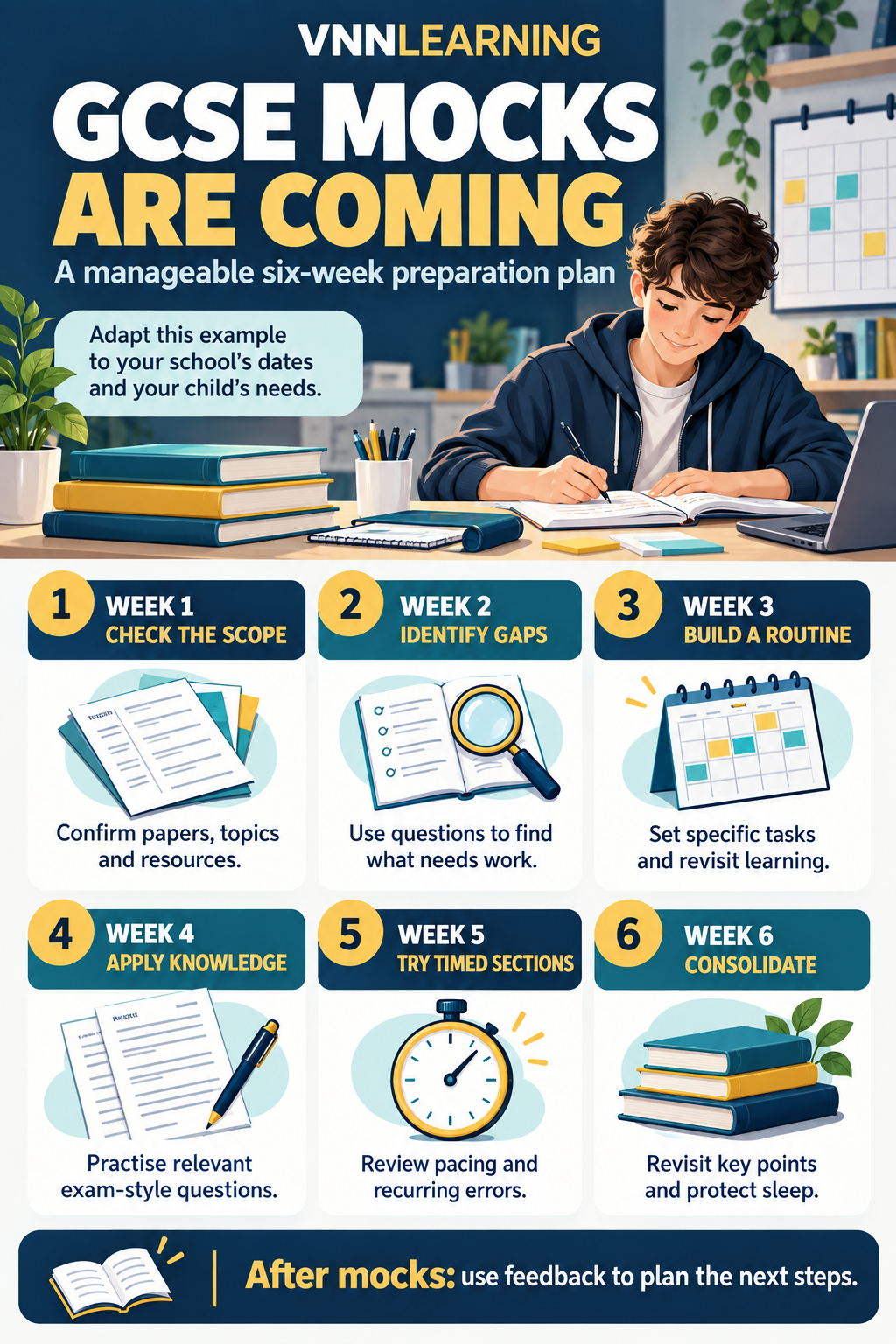
Week 1: Establish what will be assessed
Ask your teenager to collect the dates, subjects, papers and topic guidance supplied by school.
Check that revision resources match their exam board, specification and, where relevant, tier. For English literature and other option-based courses, confirm the texts or topics being assessed.
Then ask your child to complete a few representative questions.
Their answers will provide a better starting point than a judgement based only on how familiar the notes look.
Week 2: Choose the most useful gaps
Sort the topics into three groups:
- Can usually answer independently.
- Understands partly but makes mistakes.
- Needs teaching or clarification.
Give particular attention to the middle group and to essential foundations in the third. Do not spend the entire week reviewing comfortable material simply because it feels reassuring.
Set goals that describe an action. "Practise calculating percentage change" is clearer than "Revise maths".
Week 3: Build a repeatable routine
Fit revision around schoolwork and existing commitments.
Use sessions with an identifiable task and an end point. A pupil might attempt several questions, check them and correct one recurring error.
Encourage recall before checking notes. For example, they could explain a process from memory, then compare it with their class materials.
Return to important topics on later days. The timetable should create opportunities to revisit learning, rather than cross each subject off once.
Week 4: Practise using the knowledge
Move beyond collecting facts.
Your teenager may know a quotation but struggle to use it in an argument. They may recall a formula but miss when a question requires it.
Use relevant exam-style questions and review the working, explanation or structure.
Where an answer is unclear, record a question for the teacher. A list of specific uncertainties makes asking for help easier.
Week 5: Introduce realistic timed practice
Start with a section or a small group of questions if a full paper would be overwhelming.
Discuss what happened afterwards. Did your child misunderstand the command word, spend too long on one part or leave gaps in their knowledge?
Timing practice is useful when it produces a change in approach.
If access arrangements are relevant, discuss practice conditions with the school.
Week 6: Consolidate and prepare
Revisit common mistakes and key material. Check equipment, arrangements and the daily timetable.
Avoid filling the final evenings with so much work that sleep and ordinary routines disappear.
Agree what support your teenager wants on the morning of each exam. Some prefer a quiet start; others appreciate a brief practical check.
Use the results as a starting point
When marks arrive, ask what the paper shows.
Choose a few corrections and feed them into the next revision plan. A mock result is useful because it gives information about the work still to do.
VNN Learning encourages preparation that pupils can sustain: clear tasks, useful feedback and practice that gradually builds independence. If your child would like structured support before their mocks, get in touch.