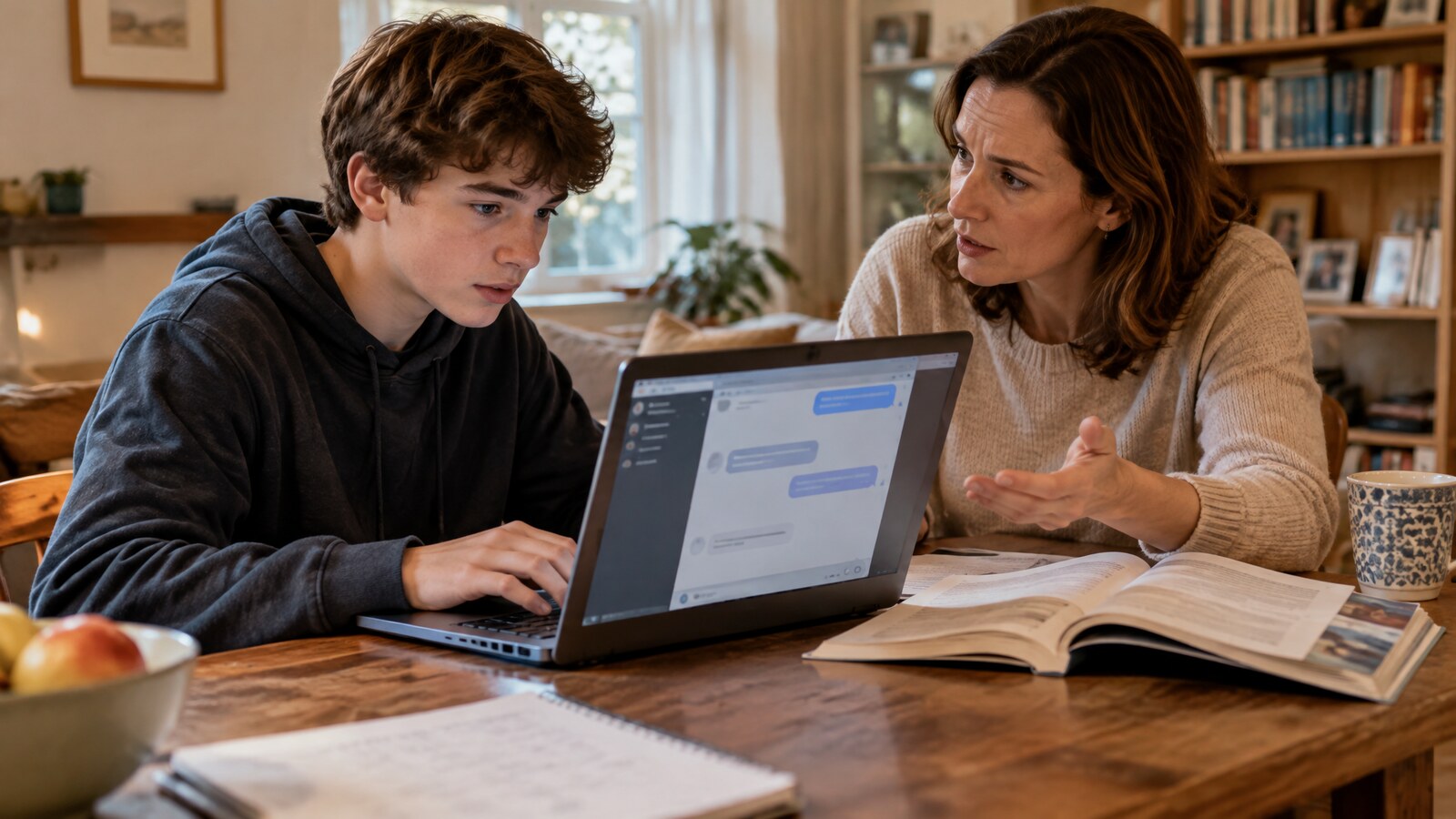
Your teenager's homework looks polished. The paragraphs flow, the answer sounds confident and the task appears complete.
But can they explain it?
That question matters whenever a pupil uses artificial intelligence for schoolwork. A finished answer tells you what is on the screen. It does not necessarily show what your child understands.
A report published on 22 September 2026, drawing on Public First polling of more than 4,000 young people in England about AI and education, highlights how widely these tools are being used. The findings concern behaviour and perceptions, rather than proof that AI improves learning.
Parents do not need to become technology experts to have a useful conversation. These five questions can help.
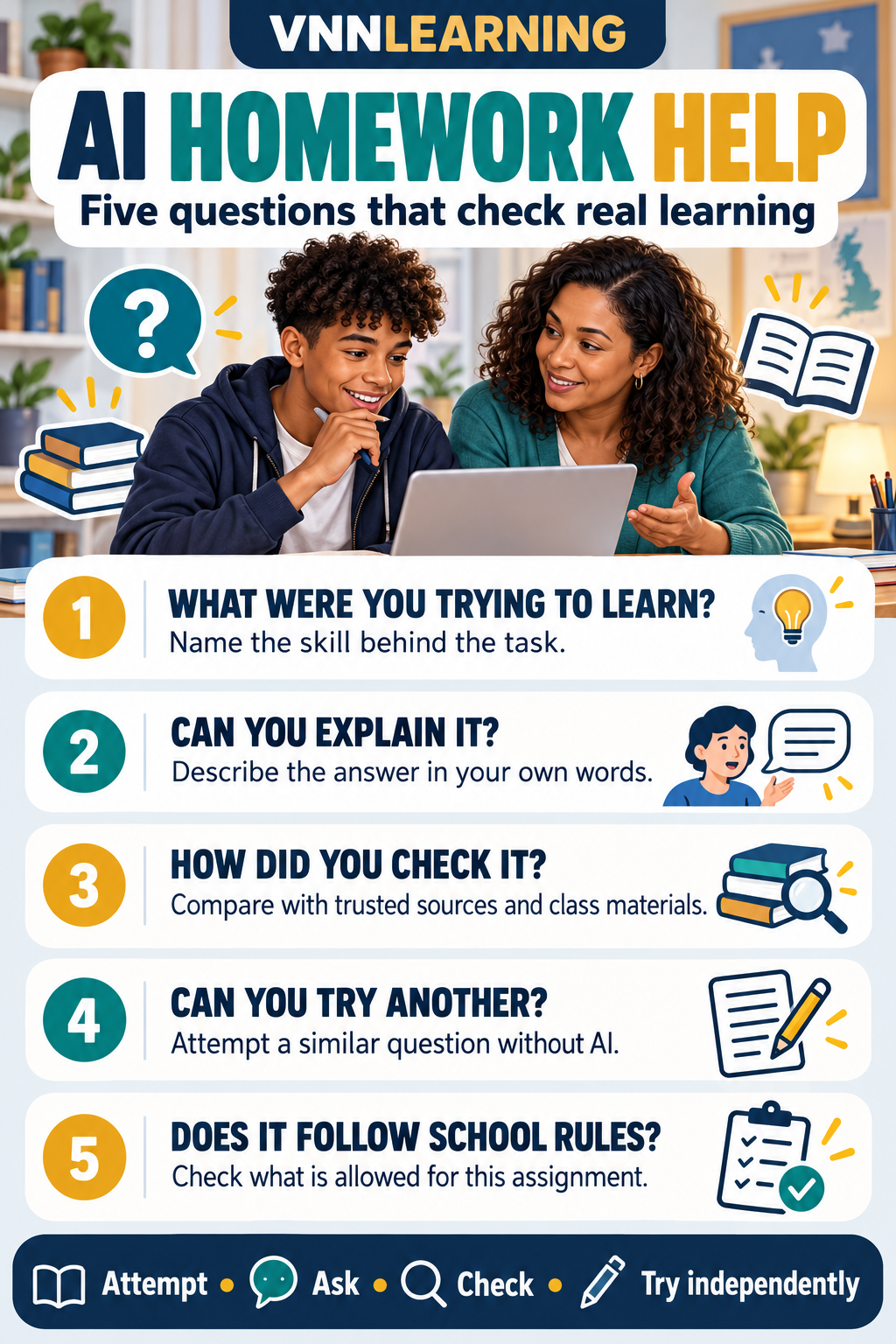
1. "What were you trying to learn?"
Begin with the purpose of the task.
Was your child learning to structure an argument, solve equations, interpret a historical source or recall scientific terminology?
If the answer is simply "I had to finish the worksheet", help them identify the skill underneath it.
Then ask what AI contributed. Did it explain an unfamiliar word? Offer a hint? Produce the entire response?
This makes the conversation specific. It also helps your teenager notice when a tool has completed the very thinking they were supposed to practise.
2. "Can you explain that in your own words?"
Choose one part of the answer and ask your child to talk you through it.
For maths, try: "Why did you use that operation?"
For English: "How does this quotation support your point?"
For science: "What causes the change you have described?"
You do not need to know every answer yourself. Listen for whether your teenager can explain the meaning, connect the steps and recognise where they are unsure.
If they cannot, treat that as a learning gap to explore. Avoid turning the conversation into an attempt to catch them out.
3. "How did you check it?"
AI-generated explanations can sound convincing even when they contain errors.
Encourage your child to compare important claims with their textbook, teacher's materials or a suitable authoritative source. A link or reference supplied by an AI tool should be opened and checked.
Ask whether the source actually supports the claim. For a calculation, ask them to check the working or try another method.
A useful household rule is: if an answer matters, your child should be able to explain how they checked it.
4. "Can you do a similar question without help?"
Change the numbers in a maths problem. Choose a different quotation. Ask for an explanation of the same concept using another example.
The task should be similar enough to test the same learning, but different enough that your child cannot simply repeat the original answer.
If they struggle, return to the missing step. Perhaps they understood the example but could not choose a method independently.
That is useful information for a teacher or tutor.
5. "Does this follow your school's rules?"
Check the rules for the particular task. Ordinary homework, coursework and formal assessments may have different requirements.
Where instructions are unclear, your teenager should ask the teacher before using AI. They should also understand any requirement to acknowledge its use.
Parents can reinforce a simple principle: submitted work must represent the pupil's own contribution in the way the assignment requires.
Agree a practical routine
For a task where AI use is permitted, try this sequence:
- Attempt the work independently.
- Identify the exact point of difficulty.
- Ask for an explanation or hint.
- Check the response.
- Close the tool and try again.
This is a suggested routine, not a guarantee that every tool or answer will be suitable. It keeps your child's thinking visible.
When homework becomes faster, ask what has improved. Is your teenager more capable, or simply producing more?
VNN Learning encourages pupils to explain, question and apply what they learn. Those habits remain valuable whatever technology is on the desk. If you would like help building those habits, get in touch.
Research source: Public First, Young People's Views on AI and Education