
Why Tutors Matter in Modern Education
Education has changed enormously over the past generation. Classrooms are no longer the only place where learning happens, and students are no longer expected to succeed through school lessons alone. In today's fast-moving academic world, tutors play an increasingly important role in helping young people build confidence, improve understanding and reach their full potential.
In the UK, tutoring has become a vital part of modern education. Parents often look for extra support when their child is preparing for SATs, GCSEs, A-levels, entrance exams or university applications. Students may need help catching up after an absence, strengthening weak areas, stretching beyond the school syllabus or simply learning in a way that suits them better. Whatever the reason, good tutoring can make a powerful difference.
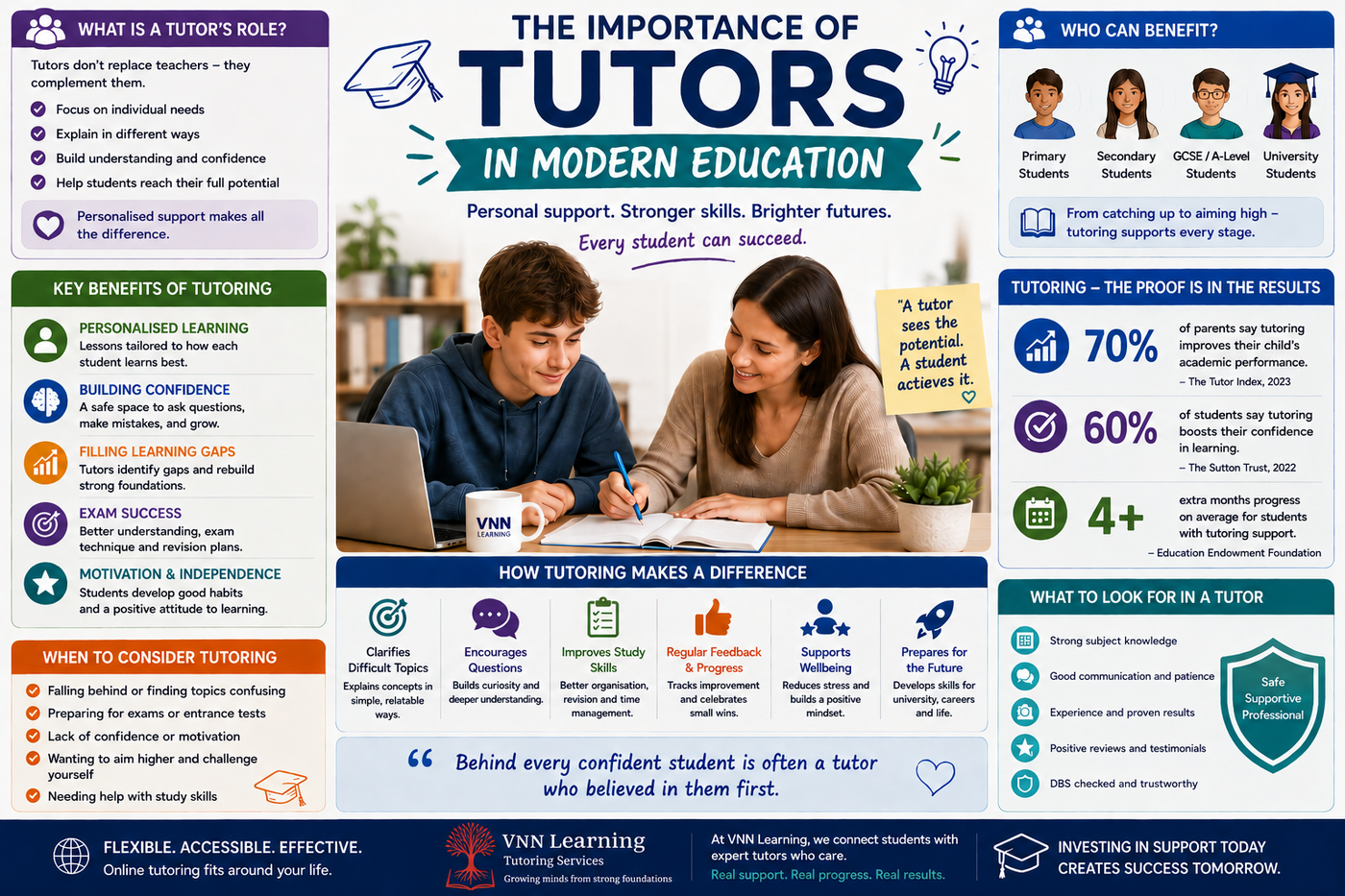
A tutor is not there to replace the teacher. Teachers do an extraordinary job, often managing large classes, broad curricula, mixed abilities, deadlines, assessments, behaviour and administrative pressures. A tutor's role is different. Tutors provide focused, personalised support that meets the individual learner exactly where they are. This personal approach is one of the main reasons tutoring has become so valuable in modern education.
Personalised Learning for Every Student
One of the greatest benefits of tutoring is personalisation. In a classroom, even the most skilled teacher must teach many pupils at once. Some students may understand a topic immediately, whilst others may need more time, a different explanation or additional practice. Because lessons must move forward, it is easy for a child to fall behind quietly.
A tutor can slow things down. They can identify exactly where the student is struggling, whether that is fractions, essay structure, algebra, comprehension, exam technique, spelling, confidence or organisation. Instead of giving every learner the same lesson, the tutor adapts the session to the individual.
This is especially important because students do not all learn in the same way. Some are visual learners who need diagrams, colour coding and examples. Others learn best through discussion, repetition, practice questions or real-life applications. A good tutor recognises these differences and adjusts their teaching style accordingly.
Personalised learning also helps students feel seen. Many young people become frustrated not because they are incapable, but because they have not yet found the method that makes the subject click. Once they receive teaching that matches their needs, their confidence can grow quickly.
Building Confidence and Self-Belief
Academic confidence is one of the most important ingredients in educational success. A student who believes they are "bad at maths" or "not clever enough for English" may stop trying long before they reach their true ability. Negative labels can become self-fulfilling if they are not challenged.
Tutors help break this cycle. In a supportive one-to-one environment, students can ask questions without fear of embarrassment. They can admit when they do not understand something. They can make mistakes privately and learn from them. This is incredibly powerful.
Many students who struggle in school are not lacking intelligence. They may simply need patience, encouragement and a safe space to rebuild their belief in themselves. A tutor can provide regular reassurance whilst also holding the student to high standards. Over time, the learner begins to think, "I can do this."
Confidence matters beyond individual subjects. A student who becomes more confident in maths, for example, may also become more willing to contribute in class, revise independently or approach difficult tasks with less anxiety. Tutoring can therefore improve not only academic results but also attitude, motivation and resilience.
Filling Gaps in Knowledge
Modern education moves quickly. Once a gap appears, it can easily grow. A child who misses a few lessons on multiplication may later struggle with fractions, percentages, ratios, algebra and science calculations. A student who never fully understands sentence structure may struggle with essays, comprehension and exam writing.
Tutors are particularly effective at identifying and filling these gaps. Rather than simply teaching the next topic, a tutor can go backwards to find the missing building blocks. This is often where real progress begins.
For example, a GCSE student struggling with quadratic equations may actually have weaknesses in negative numbers or factorising. An English student struggling with literature essays may not yet understand how to analyse quotations or organise paragraphs. A tutor can diagnose these issues and rebuild understanding step by step.
This targeted approach saves time and reduces frustration. Instead of repeatedly practising advanced material that feels impossible, the student strengthens the foundations needed to succeed.
Supporting Exam Preparation
Exams remain a major part of the UK education system. Whether students are preparing for SATs, 11 Plus, GCSEs, A-levels or entrance assessments, they need more than subject knowledge. They also need exam technique, time management, question analysis and revision strategies.
Tutors help students understand what examiners are looking for. They can teach students how to break down questions, structure answers, manage marks, avoid common mistakes and practise under timed conditions. This kind of support can make a significant difference.
Many capable students underperform in exams because they panic, misread questions, write too much on low-mark answers or fail to show their working clearly. Tutoring helps turn knowledge into performance.
A tutor can also help students create realistic revision plans. Many young people are simply told to "revise" but are never taught how. Effective revision is a skill. It involves active recall, spaced repetition, past paper practice, self-testing and reviewing mistakes. Tutors can guide students through this process and make revision feel less overwhelming.
Encouraging Independent Learning
Some people misunderstand tutoring as a form of dependency, but good tutoring should do the opposite. The aim is not for the student to rely on the tutor indefinitely. The aim is to help the student become a stronger, more independent learner.
A skilled tutor teaches methods, not just answers. They show students how to approach problems, check their work, organise notes, plan essays, revise effectively and think critically. These skills stay with the learner long after the session ends.
Independent learning is especially important as students move from primary school to secondary school, and from GCSEs to A-levels. At each stage, they are expected to take more responsibility for their own progress. Tutoring can help make that transition smoother.
The best tutors gradually shift responsibility back to the student. At first, they may provide plenty of guidance. Later, they encourage the student to explain their reasoning, attempt questions independently and evaluate their own work. This builds maturity and self-discipline.
Reducing Stress for Students and Parents
Academic pressure can affect the whole household. Parents want to help, but they may not know the current curriculum, exam requirements or best teaching methods. Homework can become stressful, especially when parent and child both feel frustrated.
Tutoring can reduce this pressure. A tutor provides calm, structured academic support from someone outside the family relationship. This can make learning less emotional and more productive.
For parents, tutoring offers reassurance. They know their child is receiving regular help, targeted feedback and professional guidance. For students, it can feel easier to ask a tutor for help than to struggle alone or argue over homework at the kitchen table.
This is particularly valuable during exam years, when stress can rise sharply. A tutor can bring structure, encouragement and a sense of control.
Helping Students Who Need Extra Challenge
Tutoring is not only for students who are struggling. Many high-achieving students benefit from tutoring because they need stretch, challenge and deeper learning.
In school, advanced learners may sometimes finish work quickly or feel under-stimulated. A tutor can introduce more complex problems, advanced reading, creative writing challenges, debate, critical thinking and preparation for selective school exams or university pathways.
This kind of enrichment helps bright students stay engaged. It can also encourage intellectual curiosity beyond the curriculum. A strong tutor does not simply push a child to achieve higher marks but helps them develop a genuine love of learning.
For ambitious students, tutoring can provide the extra refinement needed to move from good to excellent. This might include improving essay sophistication, mastering difficult mathematical concepts, developing interview confidence or preparing for competitive courses.
The Rise of Online Tutoring
Online tutoring has transformed access to education. Students no longer need to travel across town to find the right tutor. Families can connect with subject specialists from anywhere in the UK, often with far greater flexibility than traditional in-person lessons.
Online platforms allow tutors to use digital whiteboards, shared documents, interactive quizzes, screen sharing, past papers and recorded resources. For many students, this creates an engaging and efficient learning environment.
Online tutoring is especially useful for busy families, rural communities, students with mobility challenges or those who prefer learning from home. It also allows lessons to continue during bad weather, illness, travel or school disruptions.
Some parents worry that online tutoring may feel less personal, but when delivered well, it can be highly interactive. A good online tutor does not simply lecture through a screen. They ask questions, check understanding, use visual tools, provide live feedback and keep the student actively involved.
Supporting Different Learning Needs
Modern education increasingly recognises that students have different learning profiles. Some learners may have dyslexia, ADHD, autism, anxiety, processing difficulties or other additional needs. Others may simply need a quieter environment, more repetition, clearer instructions or shorter tasks.
Tutors can offer flexible support that complements school provision. Whilst tutors are not a replacement for specialist educational professionals where these are needed, they can adapt sessions to make learning more accessible.
For example, a tutor may break tasks into smaller steps, use multisensory methods, allow extra thinking time, provide visual summaries, repeat key ideas or build routines that reduce anxiety. This kind of individual attention can be life-changing for students who feel lost in larger classroom settings.
The most important thing is that the student feels respected. Good tutoring focuses on strengths as well as difficulties. It helps learners understand that needing a different approach does not mean they are less capable.
Developing Communication and Motivation
Tutoring is also about communication. A strong tutor builds rapport with the student. They learn what motivates them, what frustrates them, what they enjoy and what they fear. This relationship can make learning feel more human.
Students often work harder for someone who believes in them. When a tutor celebrates progress, notices effort and gives honest feedback, the student becomes more engaged. Motivation grows when learners can see improvement.
Tutors also help students set goals. These goals may be small, such as learning times tables, improving spelling or completing homework on time. They may be larger, such as moving up a grade, passing an entrance exam or gaining confidence before GCSEs. Clear goals give lessons purpose.
Tutors as Partners in Education
The best results happen when tutors, parents, students and schools all work towards the same goal. Tutoring should not exist in isolation. Parents can share school reports, exam dates, teacher feedback and areas of concern. Students can bring homework, revision topics or questions from class. Tutors can provide updates on progress and suggest ways to support learning between sessions.
This partnership approach makes tutoring more effective. It ensures that sessions are relevant, focused and connected to the student's wider education.
Tutors also bring an outside perspective. Sometimes they notice patterns that may not be obvious at school or home. They may identify that a student lacks confidence, rushes questions, avoids reading, struggles with planning or needs help organising revision. This insight can guide better support.
Preparing Students for the Future
Education is not only about passing exams. It is about preparing young people for life. Tutors can help students develop skills that matter far beyond the classroom, including problem-solving, communication, discipline, curiosity, perseverance and independent thought.
In a world where technology, careers and information are constantly changing, students need to know how to learn. They need the confidence to face unfamiliar challenges. They need the patience to practise difficult skills. They need the resilience to make mistakes and keep going.
Tutoring supports these qualities. It gives students the time, attention and encouragement they need to grow as learners and as people.
Conclusion
The importance of tutors in modern education cannot be overstated. Tutors provide personalised learning, fill knowledge gaps, build confidence, support exam preparation, reduce stress and encourage independent study. They help struggling students catch up, able students stretch further and anxious students believe in themselves again.
In today's educational landscape, tutoring is not a luxury reserved for a few. It is a practical, flexible and powerful form of academic support that can benefit learners of all ages and abilities.
A great tutor does more than teach a subject. They help a student discover that progress is possible. They turn confusion into clarity, hesitation into confidence and effort into achievement. In modern education, that kind of support is not only useful — it is essential.
At VNN Learning, we are proud to provide exactly this kind of dedicated, personalised support. If your child could benefit from expert tutoring, get in touch to book a free consultation and see the difference it can make.