
How To Choose Your GCSE Subjects
Picking your GCSE subjects is one of those big moments in your school adventure. There's plenty of freedom, but also a lot to think about. At age 14 or 15, knowing exactly what you want might feel like a tall order, so don't stress if you're feeling a little lost. I've been through this process myself (and have watched friends and students go through it too), so I've put together some practical advice and tips to help you figure out what subjects are the right fit for you. Let's get into it.
What Are GCSEs and Why Do They Matter?
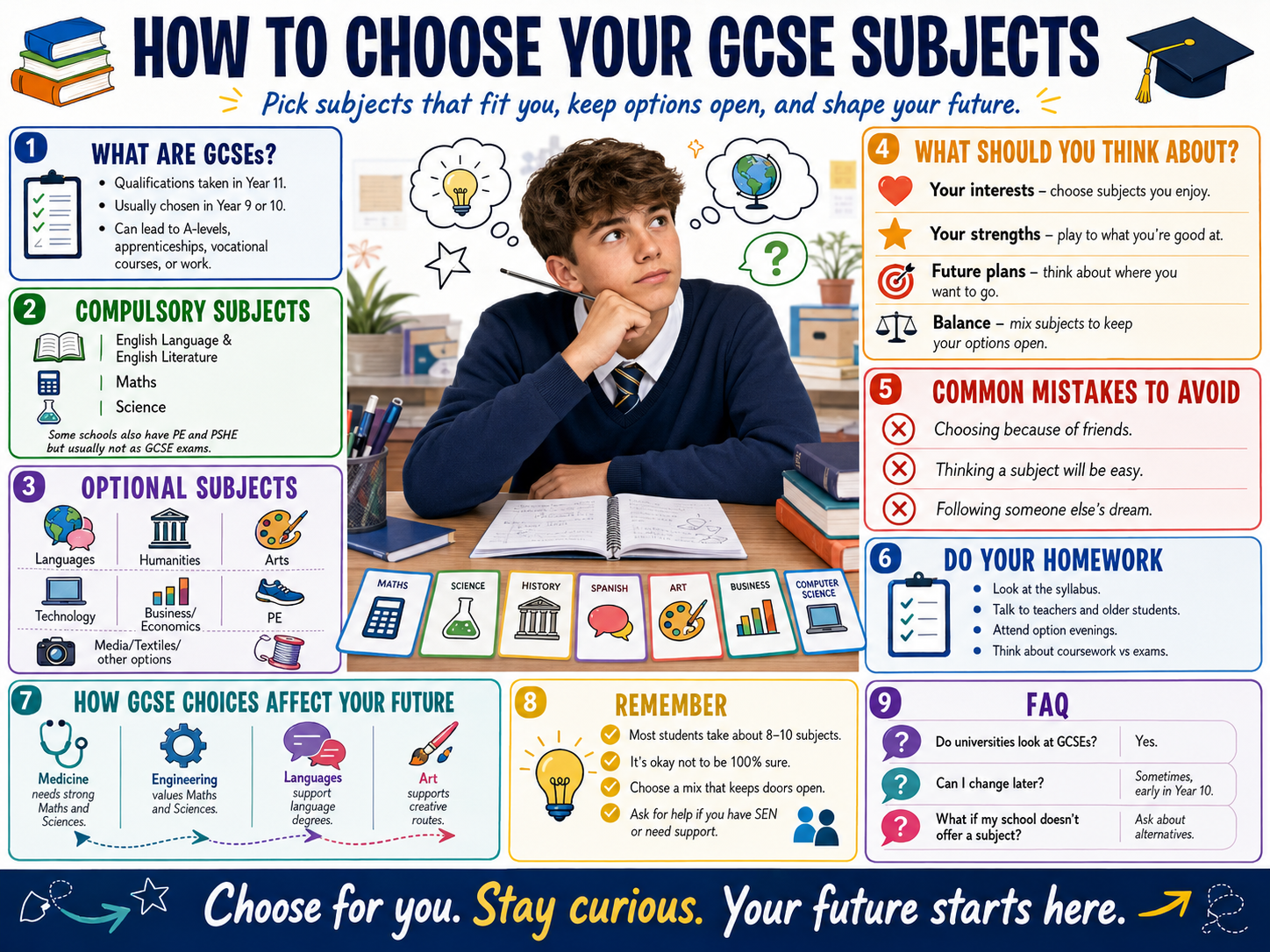
GCSEs, or General Certificate of Secondary Education, are qualifications you take at the end of Year 11 in England, Wales and Northern Ireland. You'll usually pick your subjects in Year 9 or Year 10 and study them for two years. Passing your GCSEs opens up lots of paths: A-levels, apprenticeships, vocational courses, or even going straight into work.
Some subjects are compulsory, like Maths, English Language and Science, so everyone takes those. The rest are optional, letting you shape your own education. The choices you make now can shape your future study, career routes and even the way you see the world. No pressure, right? But don't worry. If you stay thoughtful and ask for help when you need it, you'll settle on a set of subjects that really works for you. And remember: this isn't just about grades—it's about setting yourself up for a route that excites you.
Compulsory Subjects: Your Non-Negotiables
Before you start picking, it's good to know what's already decided. Every school in England and Wales requires you to take:
- English Language and English Literature. These give you skills you'll need in almost every job and higher education course.
- Mathematics. Employers and colleges really care about Maths grades.
- Science. Some schools offer Combined Science (worth two GCSEs), while others let you do separate sciences (Biology, Chemistry and Physics).
You might also have to take PE (though that's usually not a GCSE) and PSHE (Personal, Social, Health and Economic education), but those aren't exam subjects for most people. This leaves open slots for subjects you choose yourself; these optional spots are where your choices come in.
Optional Subjects: What Can You Pick?
This is where things open up and you get some freedom. Schools usually offer a mix of subjects, such as:
- Languages: French, Spanish, German or sometimes others
- Humanities: History, Geography or Religious Studies
- Arts: Art and Design, Drama, Music
- Technology: Design and Technology, Food Technology, Computer Science
- Business or Economics
- PE (Physical Education as a GCSE)
- Other specialist options depending on the school (Media Studies, Textiles and so on)
Most students end up taking around 8–10 GCSE subjects in total, including the compulsory ones. Schools might set a limit on how many you can choose, so ask your teachers or head of year if you're unsure.
If you're not sure what to pick, think about each subject's content and style. For example, Computer Science is much more about problem-solving and logical thinking compared to something like Drama, which is creative. Think about how you like to learn, too: do you prefer written essays, practical work or projects?
What Should I Think About Before Choosing?
No one wants to pick the wrong subject and feel trapped. Here's what I suggest thinking about before you lock anything in:
- Your Interests: Pick subjects that really excite you or keep you curious. It's easier to stay motivated if you genuinely like what you're studying.
- Your Strengths: If you're naturally good at a subject, you might have less stress along the way—and you might get higher grades too!
- Future Plans: Even if you're unsure now, some jobs, courses or universities look for certain subjects, like a science A-level or a language GCSE.
- Balance: Having a mix of creative, practical, written and analytical subjects is a great way to keep things interesting and grow a broad skill set.
Talking to teachers is always smart. They can explain if a subject is very exam-focused, or if you'll have to do lots of coursework. And if you're struggling to make a decision, some schools can provide extra advice or even trial classes so you can get a feel for what a subject is really like.
Common Mistakes When Choosing GCSE Subjects
I've seen a few pitfalls that students trip over, so here are some to avoid:
- Choosing Because of Friends: Picking a subject just to be with your friends rarely works out. You might not end up in the same class, and in the end, it's your results that matter.
- Thinking It'll Be "Easy": No subject is a total walk in the park. Pick based on what fits you, not what you think will be a shortcut.
- Following Someone Else's Dream: Sometimes teachers or parents push a subject, but if it's not your thing, it's okay to be honest. Respect their opinions, but your enthusiasm counts most.
Exploring Your Options: Doing a Bit of Homework
The more you know, the easier deciding gets. I usually recommend these steps to help you decide:
- Look at the Syllabus: Most exam boards post details online. Ask teachers which board your school uses, then search the "GCSE [subject] specification" for that board. Check out what you'll actually study, as real subject content might be very different from what you expect.
- Talk to People: Teachers, older students or even your parents can all give different points of view. Find out what the work is really like and if there are projects, trips or extra-curricular opportunities tied to certain subjects.
- Attend Option Evenings: Schools hold open evenings or subject taster sessions, which are definitely worth attending. You can meet teachers, ask questions and even look at students' work from previous years to get an idea of what's involved.
- Think About Homework and Assessment: Some subjects have a lot of coursework, others are mostly exams. Figure out which style you find easier, or which you'd like to get better at. And don't forget—what feels tough now might become one of your strong points with practice.
How GCSE Choices Affect Your Future
The subjects you pick can change what doors open for you down the line. Some universities and colleges ask for specific GCSEs. For instance:
- Want to get into Medicine? Most universities want top grades in Sciences and Maths, plus English.
- Looking at a foreign language degree? You'll usually need that language as a GCSE, and often an A-level too.
- Thinking of Engineering? Universities look for strong Maths and Sciences.
- Into Art or Design? An art-based subject at GCSE makes a huge difference for future creative routes.
If you have no idea yet, that's totally fine. Picking a nice mix—like one language, one humanity and a creative or technical subject—keeps doors open for the future. This approach also exposes you to different styles of learning and assessment, helping you figure out what you like best before making more specialised choices at A-level or in later studies.
It's also good to note that some schools offer vocational or skills-based GCSE subjects, such as Business Studies, which blend practical skills with academic concepts. These can be really helpful if you imagine yourself working in those sectors, or if you want a more hands-on route as part of your studies.
Special Considerations: SEN and Accessibility
If you have any learning challenges or special educational needs (SEN), check in with your school's SENCO (Special Educational Needs Coordinator). Some subjects have less written coursework, use alternative forms of assessment, or provide extra support. Schools can make adjustments if you ask—don't be afraid to seek help or get advice. The earlier you speak up, the more support your school can put in place to help you succeed.
Dealing With Uncertainty: It's Okay Not to Be 100% Sure
Choosing feels big, but the good thing is that you don't have to map out your whole life at 14. Lots of careers don't require specific GCSEs, and many skills transfer easily between subjects. Even if you change your mind later, there are often ways to catch up, retrain or take extra courses after age 16. What matters most is that you give yourself a foundation of subjects you're genuinely interested in—curiosity goes a long way towards helping you find your place.
Frequently Asked Questions About Choosing GCSEs
Do universities look at my GCSEs?
Yes. English Language and Maths are especially important. Some courses also require certain grades or subjects, but they look at the whole application, including your A-level subjects and extracurriculars.
Can I change subjects if I realise I picked the wrong one?
Maybe. There's usually a short window at the start of Year 10 for changes, but after that, swapping becomes tricky. That's why it makes sense to think things through up front.
What if my school doesn't offer the subject I want?
Check in with your teachers. Sometimes there's a way to study a subject elsewhere, or pick it up later at college. Some subjects are rare (like Latin or certain tech courses), but you can sometimes pursue them after GCSEs or through online platforms.
How many subjects should I pick?
Most students take about 8–10 subjects in total, depending on the school. It's better to focus on getting good grades than to overload yourself with too many subjects. Ask what's typical for your school, and remember that quality is just as important as quantity at this stage.
Final Thoughts on Making Your Choice
Thinking carefully about your GCSE choices can help you feel more confident heading into Year 10. Stay true to what interests you and talk things over with people you trust. Check out all the info you can—go to open evenings, ask teachers and talk things through with your family. Remember there's always room to adapt later if your plans change. Whatever you pick, it's important to put in effort and keep a positive attitude towards learning new things. This is your adventure; take the path that makes you excited for what's next!
At VNN Learning, we support students across all their GCSE subjects — helping them build confidence, master tricky topics and stay on track for the grades they need. Whether you've just chosen your options or you're deep into revision, our tutors are here to help.
Want expert support with your GCSEs? Get in touch for a free consultation.